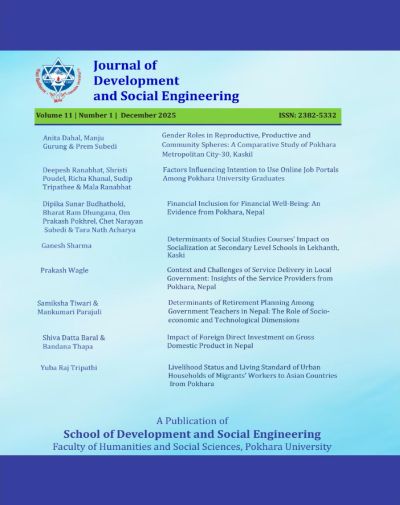
Factors Determining Retirement Planning among Government Teachers in Nepal: The Role of Socio-economic and Technological Dimensions
Keywords:
Financial Literacy, Government School Teachers, Pension Scheme, Retirement Planning, Saving BehaviorAbstract
Retirement planning plays a crucial role for assuring economic and emotional well-being in later life. Although its significance is well acknowledged, there are several barriers for the preparation of post retirement plan such as inadequate financial literacy, saving, low access to digital financial tools which serve as an impediment for effective retirement planning. This study explores the effect of socio economic, and technological factors on retirement preparedness among government school teachers in Pokhara Metropolitan City. Adopting a cross-sectional research design, data were collected from 144 respondents who were selected through purposive sampling. To assess the association between different variables such as income level, saving behavior, gender, technological literacy and retirement confidence, Chi-square test was used. As revealed by the result, higher income and greater saving are associated with greater retirement confidence. There is gender differences in the retirement preparedness as male are found to have well preparedness than their female counterpart. Another significant factor affecting retirement planning in this hi-tech world is digital literacy as teacher with digital literacy are more confident in their retirement planning. Gender, financial stability, digital skill are important factors of retirement planning. In order to make post-retirement life fulfilling, the intervention should be done in the area such as financial literacy programme, gender responsive support mechanism and access to digital financial services.
Downloads
Published
Issue
Section
License
Copyright © Journal of Development and Social Engineering, School of Development and Social Engineering, Faculty of Humanities and Social Sciences, Pokhara University. All rights reserved. The School of Development and Social Engineering, Pokhara University holds the exclusive copyright of all the contents of this journal. No part of this journal may be reproduced or transmitted by any media or publishing organizations including websites without the written permission of the copyright holder. The contents of this journal are available for any citation, using a recognized and proper referencing system.

