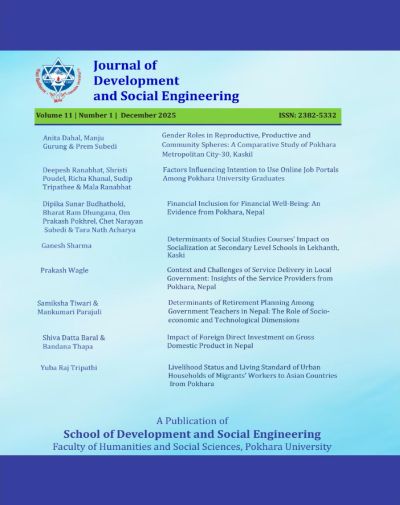
Livelihood Status and Living Standard of Urban Households of Migrants’ Workers to Asian Countries from Pokhara
Keywords:
Households, livelihood status, living standard, migrants, migrant workersAbstract
Asian emigrants’ households’ livelihood status is significantly increased due to the emigration. The study aims to describe the livelihood status and living standard of urban households of migrant workers to Asian countries from Pokhara, Nepal. The main concern of this paper is whether migrant workers' family livelihood status is better or not. The theoretical background of the study is the Department for International Development Livelihood Framework, and it studied the five capitals: social, financial, physical, human, and environmental. The descriptive and explanatory research design was applied. For the study, Pokhara Metropolitan City was chosen purposively, and ward number 13 was chosen by lottery method. The data was collected from 127 migrant worker households through face-to-face interviews using semi-structure questionnaire, and along with the two key informant interviews. Both descriptive and inferential analysis (Chi-square test) were employed to accomplish the study objectives. This study revealed that foreign labor migration has greatly increased income levels and material well being in households in Pokhara, making it a crucial livelihood strategy. While human capital gains slightly from better access to healthcare and education, remittances mostly increase financial and physical capital through consumption and asset accumulation. Weak association between livelihood outcomes and pre departure skill training, however, points to systemic deficiencies in migration governance. Social capital is still underdeveloped despite economic advancements, which suggests low levels of social cohesiveness and community involvement. Reduced reliance on natural resources is suggested by favorable views of environmental capital. In general, migration raises living standards over national averages, but its advantages vary depending on the livelihood capital. Therefore, policies that continue to facilitate migrant workers while also strengthening social capital, encouraging skill learning, and productive investment are necessary to achieve sustainable livelihood outcomes. Future researchers would be better applied using mixed methods with large samples.
Downloads
Published
Issue
Section
License
Copyright © Journal of Development and Social Engineering, School of Development and Social Engineering, Faculty of Humanities and Social Sciences, Pokhara University. All rights reserved. The School of Development and Social Engineering, Pokhara University holds the exclusive copyright of all the contents of this journal. No part of this journal may be reproduced or transmitted by any media or publishing organizations including websites without the written permission of the copyright holder. The contents of this journal are available for any citation, using a recognized and proper referencing system.

