Correlation of Arterial Blood Gas Parameters with the Duration of Proning in Awake Non-intubated COVID-19 Patients- A Retrospective Observational Study
Keywords:
Arterial blood gas, non-invasive ventilation, prone positioning, severe acute respiratory distress syndrome Coronavirus-2Abstract
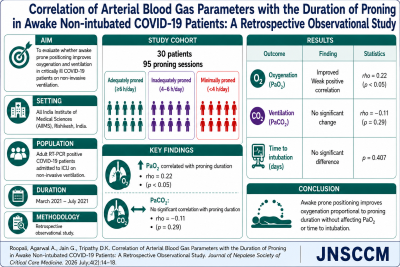
Background and aims: Prone positioning (PP), which has been known for decades to increase oxygenation in mechanically ventilated patients with moderate to severe acute respiratory distress syndrome (ARDS), was also practiced in Coronavirus disease (COVID-19) patients. We hypothesized that prone positioning in critically ill COVID-19 patients would improve oxygenation and ventilation and potentially translate into improved survival.
Methods: A retrospective, observational study was conducted in All India Institute of Medical Sciences, Rishikesh, from March 2021 to July 2021. SARS- CoV-2 reverse transcriptase – polymerase chain reaction (RT-PCR) positive adult patients admitted to the ICU on non-invasive ventilation were included in the study. Proning durations were categorised as adequately proned (at least six hours/day), inadequately proned (four to six hours/ day) and minimally proned (less than four hours/ day).
Results: The 30 included patients underwent 95 proning sessions. The change in PaCO2 had no statistically significant correlation with the duration of proning in hours (rho= -0.11, p = 0.295). There was a statistically significant weak positive correlation between the change in PaO2 and duration of proning in hours (rho = 0.22, p<0.05). For each hour of proning, percent increase in PaO2 was by 0.44 percent. There was no significant difference between the groups in terms of time to intubation (days) (p = 0.407).
Conclusion: This study demonstrated that prone positioning in awake, non-intubated COVID-19 patients with acute respiratory failure improves oxygenation proportional to proning duration without affecting PaCO2 levels.
Downloads
Published
How to Cite
Issue
Section
License

This work is licensed under a Creative Commons Attribution 4.0 International License.
This license allows reusers to distribute, remix, adapt, and build upon the material in any medium or format, so long as attribution is given to the creator. The license allows for commercial use.


