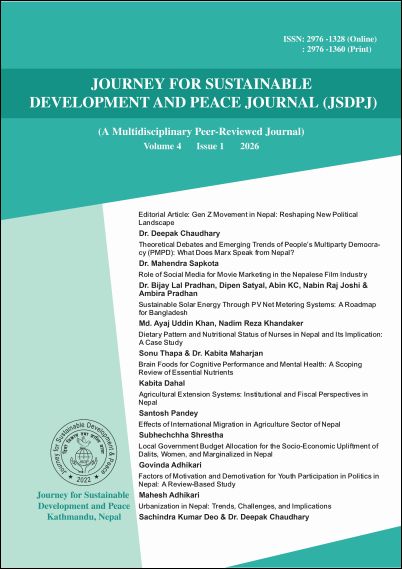
Theoretical Debates and Emerging Trends of People’s Multiparty Democracy (PMPD): What Does Marx Speak from Nepal?
Keywords:
People’s Multiparty Democracy (PMPD), JaBaJa, Marxism, political theory, philosophy, NepalAbstract
This paper is an analysis of the Marxist construction of People Multiparty Democracy (PMPD) in Nepal specifically touching on the theoretical underpinnings, the changing interpretations and the current significance. Madan Kumar Bhandari defined PMPD in the early part of the 1990s, which was aimed at aligning revolutionary Marxist ideology with democratic pluralism. The research applies both systematic review of literature and argumentative synthesis of theoretical discussions and political constructs. The paper reveals the potentialities that PMPD had opened up the democratic participation in as well as contradictions and disjuncture that perennially defined its enactment. So, it is the critical question how the theorization of PMPD can be made and inserted the message as if Marx is giving to the rest of world in the version of PMPD, i.e. Janatako Bahudaliya Janawad (JaBaJa). Its construction is rooted with dialectical materialism, and it navigates some neo-Marxist and post-modernist logic replacing conventional nature of movement, class struggle and socio-political changes. The discussion indicates that PMPD/ JaBaJa continues to be an intellectual discourse, as well as a field of political contestation.
Downloads
Published
How to Cite
Issue
Section
License

This work is licensed under a Creative Commons Attribution-NonCommercial 4.0 International License.
This license enables reusers to distribute, remix, adapt, and build upon the material in any medium or format for noncommercial purposes only, and only so long as attribution is given to the creator.

