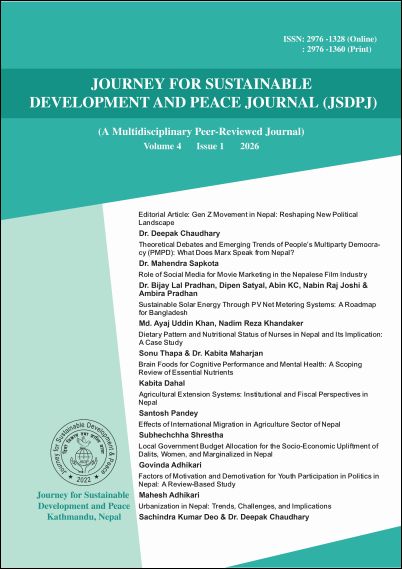
Local Government Budget Allocation for the Socio-Economic Upliftment of Dalits, Women, and Marginalized in Nepal
Keywords:
Allocation, budget, causes, Dalits, local government, womenAbstract
This study analyzes the inclusive provisions amidst exclusive practice in the context of local government budgeting in Nepal. The Constitution of Nepal (2015) mandates affirmative action for marginalized groups. This is reinforced by the Local Government Operation Act (2017) and related guidelines, including tools like LISA, which set an ideal benchmark of allocating at least 10% of local discretionary budgets for the socio-economic upliftment of Dalits, women, and other marginalized communities. The qualitative study employs document analysis of legal provisions, scholarly papers, and municipal budget review reports to evaluate the extent of inclusive budgeting in practice. Findings reveal a broad policy-implementation gap, with most local governments allocating fewer than 2% of their budgets to the marginalized. Elite capture persists, benefiting highly visible infrastructure schemes at the cost of social empowerment and rendering participation more tokenistic. Accountability arrangements remain absent, as functionary’s municipality budget constraints while diverting funds into politically opportune schemes. Without stronger enforcement, capacity-building, and transparent oversight, Nepal’s inclusive governance provisions risk remaining symbolic. This study provides valuable insights for policymakers, practitioners, and scholars committed to advancing equitable and effective local development.
Downloads
Published
Issue
Section
License

This work is licensed under a Creative Commons Attribution-NonCommercial 4.0 International License.
This license enables reusers to distribute, remix, adapt, and build upon the material in any medium or format for noncommercial purposes only, and only so long as attribution is given to the creator.

