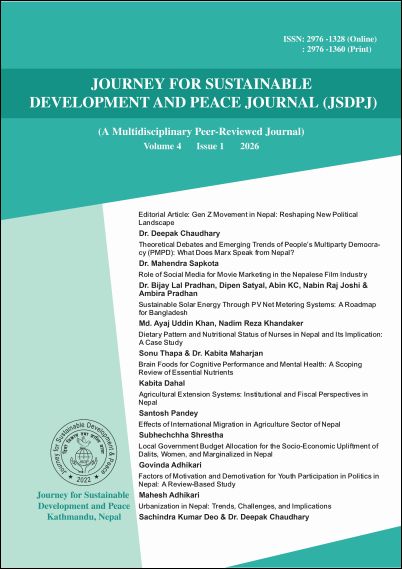
Factors of Motivation and Demotivation for Youth Participation in Politics in Nepal: A Review-Based Study
Keywords:
Youth politics, motivation, demotivation, governance, NepalAbstract
It is widely recognized that youth participation is one of the fundamental elements of democratic strength, political renewal, and inclusive governance. In Nepal, young people have traditionally played central roles in political mobilizations and regime change; however, their ongoing participation in institutional political processes remains limited and unreliable, with infrequent and inconsistent expressions. In this context, this paper synthesizes a review of scientific readings and argumentations that explores the incentives and disincentives that affect youth participation in Nepalese politics, combining theoretical and empirical findings. Following the IMRAD format, international and Nepalese scholarly surveys are used to outline the personal, institutional, and structural factors underlying youth political participation. Based on the age-based demarcation of the age of youth suggested by the Nepal National Youth Policy 2082 (BS) that defines youth as the age group between 16 and 40 years, the review concludes that political socialization, mobilization on the basis of issues, political aspirations based on democracy, and digital activism are promoters of participation among youths, and that hierarchical party structures, political violence, clientalism, corruption, and economic insecurity are de-motivators to prolonged participation. The article concludes with an identification of research gaps and policy implications to strengthen substantial youth participation in Nepalese democracy.
Downloads
Published
Issue
Section
License

This work is licensed under a Creative Commons Attribution-NonCommercial 4.0 International License.
This license enables reusers to distribute, remix, adapt, and build upon the material in any medium or format for noncommercial purposes only, and only so long as attribution is given to the creator.

