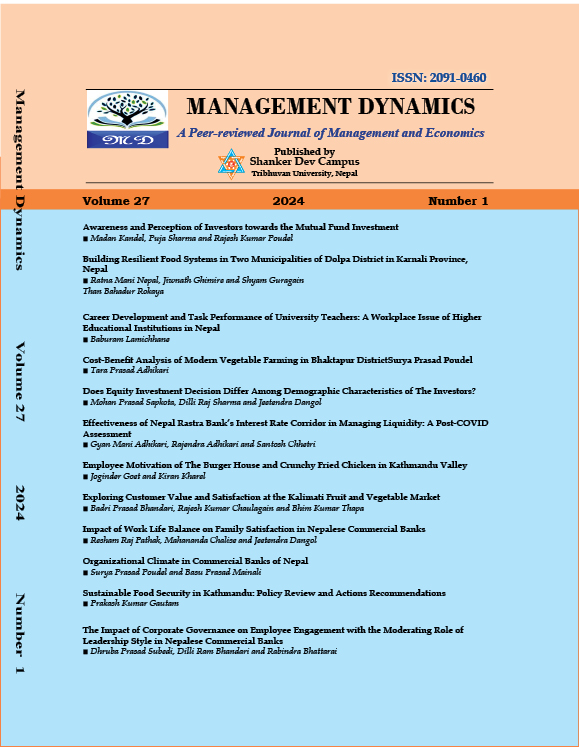
Impact of Work Life Balance on Family Satisfaction in Nepalese Commercial Banks
Keywords:
Family satisfaction, work-family conflict, family-work conflict, work-life balanceAbstract
This study aims to examine the association between work-life balance and employee outcomes in Nepalese commercial banks. The banking sector in Nepal, characterized by long working hours and high stress, presents a unique context for examining WLB dynamics. This study addresses gaps in the literature by exploring the influence of WFC and FWC on FS, offering insights for policymakers and organizational leaders in developing economies. To examine the relationship between work-life balance (WFC/FWC) and analyze the influence of work-life balance (WFC/FWC) on employees’ family satisfaction (FS) in a Nepalese commercial bank. The research employs a cross-sectional design with a sample of 584 employees selected via convenience sampling. This study used correlation and regression analysis to analyze the data. A one-sample t-test, factor analysis (PCA), and reliability analysis using Cronbach’s alpha were used to identify the constructs and test the hypotheses. Independent variable WFC and FWC with Beta coefficient is -.268 and -.260, showed a statistically negative relationship with the dependent variable FS. Thus, if WFC decreases, Family Satisfaction increases. Similarly, if FWC decreases, Family Satisfaction increases. These results significantly support the alternative hypotheses. The study revealed an inverse relationship between Work-Family Conflict(WFC) and Family Satisfaction(FS). Lower ranks of WFC and FWC are related to higher levels of Family Satisfaction.
Downloads
Published
How to Cite
Issue
Section
License
Copyright © Research Management Cell, Shanker Dev Campus

