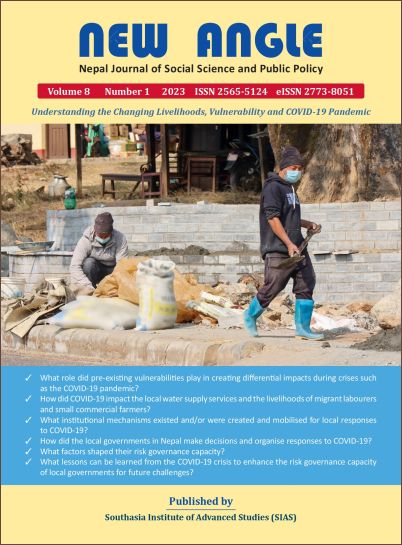
Governing disaster risks locally: Insights from COVID-19 responses by local governments in a federalising Nepal
Keywords:
COVID-19, decentralisation, disaster management, governing capacity, institutions, NepalAbstract
Local risk governance is an underexplored topic in disaster risk management and decentralisation literature. Key knowledge gaps centre around whether and to what extent the devolution of authority leads to effective local responses to disaster risk. In this paper, we assess the local government’s response to COVID-19 risk in Nepal as a contribution to filling this knowledge gap. The COVID-19 crisis hit Nepal soon after officials were elected for the newly created local governments (Palikas) as part of the new federal governance reform. Drawing on the evidence from eight Palikas, we identify key factors determining local risk governing capacity. We found some Palikas were better able to provide immediate local response to COVID-19 than others, and we discuss why. Most of the Palikas faced constraints to provide health services such as COVID tests and treatments to infected patients. Our analysis shows that the ability of Palikas to respond to the risk was shaped by two key factors: a) the functioning of institutional mechanisms and decision-making abilities and b) the ability to access and mobilise resources including financial and human resources, infrastructure, and knowledge. This analysis shows that devolution of power alone is not a main criterion of local risk governance capacity and suggests the need to consider other factors that shape local institutional capacity.
Downloads
Published
How to Cite
Issue
Section
License
Copyright (c) 2023 The Author(s)

This work is licensed under a Creative Commons Attribution-NonCommercial 4.0 International License.
This license enables reusers to distribute, remix, adapt, and build upon the material in any medium or format for noncommercial purposes only, and only so long as attribution is given to the creator.

