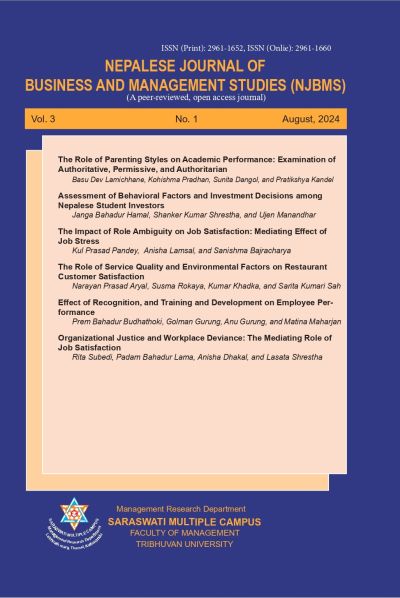
Organizational Justice and Workplace Deviance: The Mediating Role of Job Satisfaction
Keywords:
workplace deviance, Distributive justice, interactional justice, job satisfaction, procedural justiceAbstract
The purpose of this study was to investigate how organizational justice comprising procedural, distributive, and interactional justice influences on workplace deviance through job satisfaction among employees working in academic institutions in the Sorhakhutte , Kathmandu. Thus, this research employed descriptive and causal research designs to reflect the general background of survey participants and to test the formulated research hypotheses of the study. Further, the structured questionnaires utilized in the study for cross-sectional primary sources of Therefore, this study used 106 useful data for the analysis. Descriptive statistics and regression analysis were used to evaluate the study hypotheses. The findings demonstrate a substantial adverse effect of organizational justice and job satisfaction on workplace misbehavior. Furthermore, organizational justice has a beneficial impact on work satisfaction. Job satisfaction partly mediates the association between distributive justice, procedural justice, and workplace deviance, underscoring the significance of equity and support in alleviating deviant behavior. Job satisfaction does not serve as a mediator in the link between interactional justice and workplace misbehavior. These results underscore the essential function of management in fostering equity and justice to improve job satisfaction and mitigate workplace deviance.
Downloads
Published
How to Cite
Issue
Section
License

This work is licensed under a Creative Commons Attribution-NonCommercial 4.0 International License.
This license enables reusers to distribute, remix, adapt, and build upon the material in any medium or format for noncommercial purposes only, and only so long as attribution is given to the creator.


