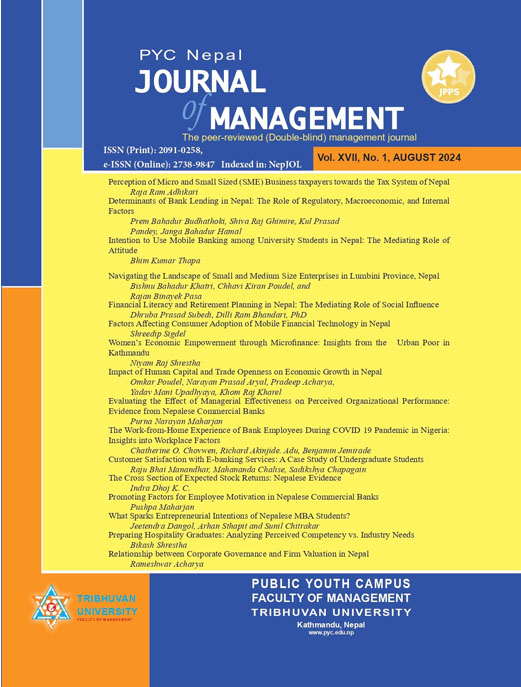
Determinants of Bank Lending in Nepal: The Role of Regulatory, Macroeconomic, and Internal Factors
Keywords:
capital, liquidity, concerntratin, regulatory quality, rule of lawAbstract
This study examines how the rule of law, regulatory quality, internal factors, and macroeconomic factors affect bank lending. Arellano-Bond and Blundell-Bond estimators are used in this study to analyze how predictor variables affect response variable. The study utilizes balanced panel data from 220 observations from twenty Nepalese commercial banks for the period from 2012 to 2022. The findings reveal that the lagged value of loans and advances positively and significantly impacts the loans and advances of the current year. Similarly, bank concentration, capital adequacy, and liquidity positively affect the loans and advances made by Nepalese commercial banks, contributing to the banking industry’s stability. On the other hand, lending rates significantly and negatively impact loans and advances. Conversely, regulatory quality and the rule of law positively impact Nepalese commercial banks’ loans and advances. On the other hand, advances and loans are adversely affected by inflation rates. Lastly, a notable positive correlation exists between predictor variables like GDP growth rates and loans and advances. This study emphasizes the significance of regulatory quality, macroeconomic stability, and internal bank factors in shaping bank lending practices. It indicates that improving regulatory frameworks, ensuring capital adequacy, and managing inflation can promote stable lending in Nepalese banks.
Downloads
Published
How to Cite
Issue
Section
License
© Public Youth Campus

