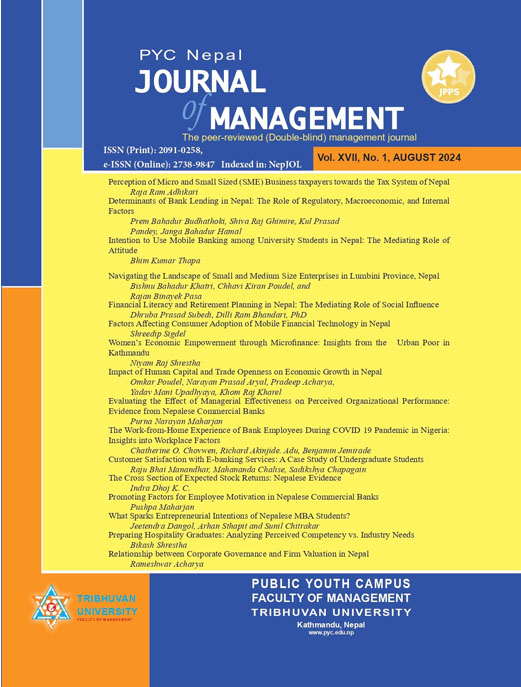
Relationship between Corporate Governance and Firm Valuation in Nepal
Keywords:
Corporate governance, Tobin Q, board size, CEO duality, audit committeeAbstract
This study examines the effect of corporate governance mechanisms on firm valuation among 54 firms listed on the Nepal Stock Exchange over two fiscal years. A descriptive and causal-comparative research design was adopted to assess how board size, board independence, CEO duality, and audit committee presence influence firm performance, measured by Tobin’s Q. Data were obtained from secondary sources, and statistical tools including descriptive statistics, Pearson correlation, and multiple linear regression were applied using SPSS software. The results show that board size has a positive and statistically significant impact on firm valuation, indicating that larger boards may enhance decision-making and oversight. CEO duality has a significant negative effect, suggesting that role separation contributes to better governance and firm value. However, board independence and the presence of an audit committee show no significant influence, reflecting their limited functional role in the Nepalese context. These findings highlight the contextual nature of governance effectiveness and the gap between formal structures and practical implementation. The study concludes that enhancing board effectiveness and leadership structure is critical for improving firm valuation, and recommends strengthening regulatory enforcement and governance practices in emerging markets like Nepal.
Downloads
Published
How to Cite
Issue
Section
License
© Public Youth Campus

