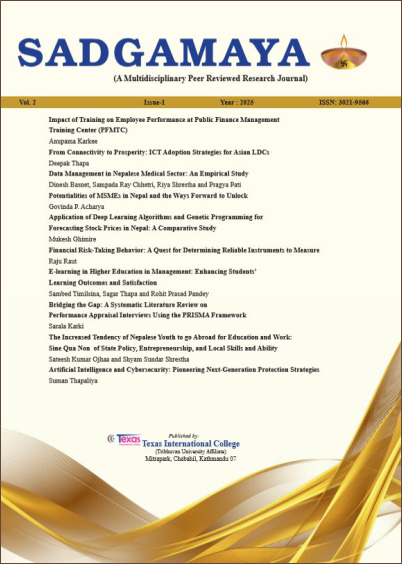
Financial Risk-Taking Behavior: A Quest for Determining Reliable Instruments to Measure
Keywords:
scale development, behavioral finance , financial risk-taking behaviorAbstract
This study intends to provide a consistent and valid instrument for assessing financial risk-taking behavior by overcoming the shortcomings of current tools, including cultural bias and theoretical inadequacies. Drawing from behavioral finance and psychology theories, the study investigates how human characteristics (e.g., risk tolerance, overconfidence), economic circumstances, financial literacy, and cultural settings affect financial decision-making. The study finds four essential aspects of financial risk-taking behavior using qualitative and quantitative methods, including factor analysis and network analysis: Financial Risk-Taking, Psychological and Social Risk-Taking, Risk Aversion and Safety, and Thrill-Seeking. Data suitability for factor analysis is confirmed by the Kaiser-Meyer-Olkin (KMO) score of 0.683 and a notable Bartlett's Test of Sphericity. Initially, twelve things were tested; eleven were kept following examination. The tool shows reasonable psychometric qualities, providing a more complex view of risk-related behavior in several contexts. The network study confirms the structural links among the variables even more. By giving a culturally flexible, theoretically based, and empirically validated scale appropriate for both academic research and practical financial counseling, this work adds to behavioral finance.
Downloads
Published
How to Cite
Issue
Section
License
Reproduction of this journal or any part of it without the permission of the Publisher is strictly prohibited.

