In vitro morphogenesis and callus induction from nodal explants of Rubia manjith Roxb. ex Fleming
Keywords:
BAP, MS media, NAA, node culture, tissue cultureAbstract
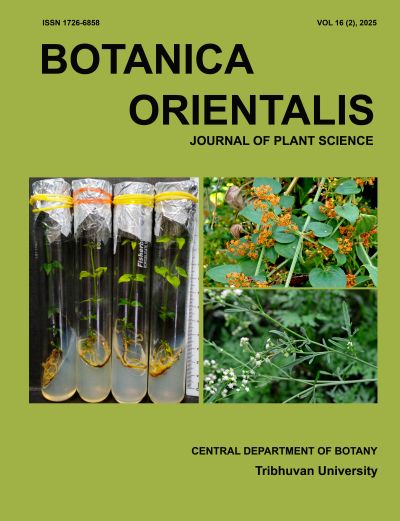
Rubia manjith, a perennial herbaceous climber, is one of the important medicinal and dye plants prioritized for research and development in Nepal. It is categorized as a vulnerable species in Nepal. Locally, this plant is used by various communities to treat different ailments. However, unsustainable exploitation and large-scale export have led to a decline in its wild populations. The present study aims to develop a standardized protocol for in vitro propagation of the species through organogenesis. Nodal explants of R. manjith were cultured in Murashige and Skoog (MS) medium supplemented with various combinations of plant growth regulators: BAP and NAA. Cultures were incubated at 25 ± 2°C with a 16/8-hour light/dark cycle and a light intensity of ± 3000 lux. Callus induction was highest in MS medium supplemented with either 2.0 mg/L NAA or 0.1 mg/L BAP + 1.0 mg/L NAA. The highest mean shoot number of 8.33 ± 0.33 and root number of 8.00 ± 1.00 were observed on MS medium without any growth regulators. The greatest shoot length (14.33 ± 1.54 cm) was observed on MS medium supplemented with 0.1 mg/L BAP, while the highest root length (6.80 ± 1.27 cm) was observed with 2.0 mg/L BAP. The in vitro-grown plants propagated from nodal segments can be transplanted as needed to support wild populations and promote large-scale cultivation.
Downloads
Published
Issue
Section
License
Copyright (c) 2025 Central Department of Botany, Tribhuvan University, Botanica Orientalis

This work is licensed under a Creative Commons Attribution-NonCommercial-NoDerivatives 4.0 International License.
This license enables reusers to copy and distribute the material in any medium or format in unadapted form only, for noncommercial purposes only, and only so long as attribution is given to the creator.

