
Spatial non-stationarity in forest fire driving factors in the lowlands of Nepal: A case study of Madhesh Province
Keywords:
Forest fires, Generalised linear model (GLM), Geographic weighted regression (GWR), Risk map, Spatial heterogeneityAbstract
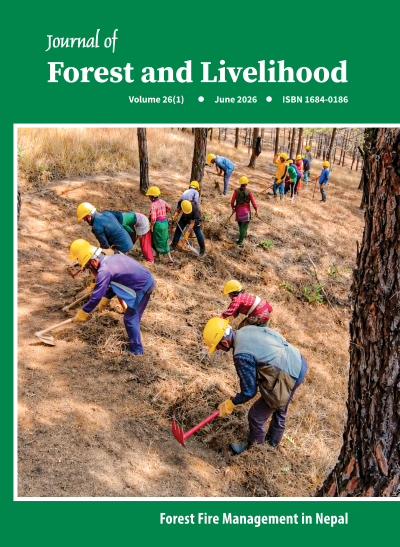
Madhesh Province, located in the southern lowlands of Nepal, experiences frequent forest fires under strong human–forest interactions. Previous fire-risk studies in Nepal rarely account for spatial non-stationarity in the relationships between fire occurrence and its drivers. We aggregated VIIRS (2012–2023) active-fire detections to 136 local administrative units and modelled municipal fire counts using a Poisson generalised linear model (GLM) and a Poisson geographically weighted regression (GWR). Across the province, aspects, land surface temperature, rangeland and agricultural area, canopy height, NDVI, and road length were generally positively associated with fire counts, whereas precipitation and wind speed were negative; several land-cover and anthropogenic variables showed spatially varying effects in the GWR. The local GWR improved model fit (deviance explained = 0.994) compared with the global GLM (0.913), both trained with fire incidents from 2012-2022, and produced a more accurate prediction map (AUC = 0.825 vs 0.769, validated using 2023 fire detections). Both models indicated that ~22 per cent of Madhesh Province falls within high fire-risk zones. Overall, accounting for spatial heterogeneity improves forest-fire risk mapping in Nepal’s lowlands and supports locally tailored prevention and preparedness strategies.
Downloads
Published
How to Cite
Issue
Section
License
Copyright (c) 2026 ForestAction Nepal

This work is licensed under a Creative Commons Attribution-NonCommercial 4.0 International License.
CC-BY-NC: This license allows reusers to distribute, remix, adapt, and build upon the material in any medium or format for noncommercial purposes only, and only so long as attribution is given to the creator.

