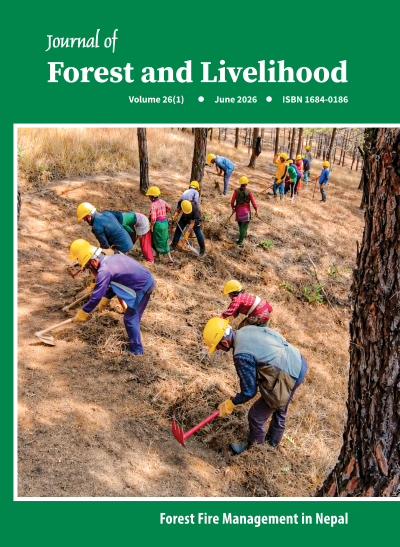
Challenges and opportunities in forest fire management in Nepal: An economic perspective
Keywords:
Biomass, Climate change, Externalities, Forest management, IncentiveAbstract
Climate change and human negligence are often cited as main drivers of forest fires in Nepal. However, this perspective argues that these factors are the result of underlying economic and institutional failures in forest management. Reduced interactions between forests and people, protection-oriented forest management practices, and weakened forest-agriculture interactions have led to underutilisation of forest biomass and the accumulation of combustible fuel. Consequently, recurrent and intense forest fires have emerged as negative externalities, where social costs exceed private benefits. Although they have caused significant economic, environmental, and health costs, the prevention and suppression of forest fires are not viewed as co-benefits of forest management. Hence, aligning forest fire management with biomass utilisation, incentive mechanisms, and climate policy commitments can help convert fire prevention into a long-term investment for sustainable forest management in Nepal.
Downloads
Published
How to Cite
Issue
Section
License

This work is licensed under a Creative Commons Attribution-NonCommercial 4.0 International License.
CC-BY-NC: This license allows reusers to distribute, remix, adapt, and build upon the material in any medium or format for noncommercial purposes only, and only so long as attribution is given to the creator.

