
Institutional fragmentation and forest fire management in federal Nepal: Bridging the governance gap through incident management systems
Keywords:
Forest Fire, Emergency response, Legislative conflict, Coordination mechanism, Forest governanceAbstract
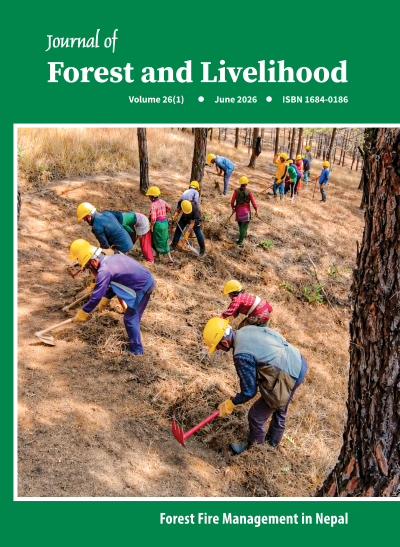
Nepal is facing an increasing forest fire crisis, with more than 34,725 incidents recorded from 2008 to 2021, leading to approximately 800 deaths and NPR 22 billion in economic losses. Although forests cover 46 per cent of the country, management efforts are greatly hindered by institutional fragmentation following Nepal’s 2015 shift to federalism. This paper explores how constitutional ambiguities, especially overlapping mandates in Schedules 5, 6, 7, and 9, along with conflicting laws such as the Local Government Operation Act (2017) and the Forest Act (2019), create diagonal accountability and jurisdictional disputes. We contend that these structural gaps lead to at least six layers of administration between policy formulation and operational response, causing ad hoc coordination during critical fire periods. By examining successful Incident Management System (IMS) models from the United States and Australia, this study proposes a step-by-step approach to incorporate Nepal’s Community Forest User Groups (CFUGs) into a standardised, expertise-based command structure. Launching pilot programs at the municipal level can help Nepal move ahead of top-down legislative delays and foster "ground-level" operational unity. This analysis presents a scalable model for disaster governance in emerging federal states facing challenges related to decentralised resource management.
Downloads
Published
Issue
Section
License

This work is licensed under a Creative Commons Attribution-NonCommercial 4.0 International License.
CC-BY-NC: This license allows reusers to distribute, remix, adapt, and build upon the material in any medium or format for noncommercial purposes only, and only so long as attribution is given to the creator.

