
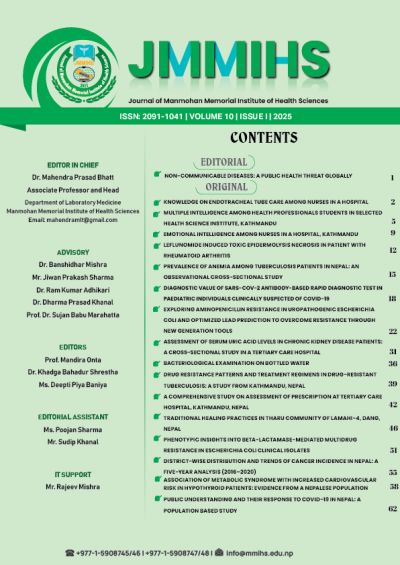
Assessment of Serum Uric Acid Levels in Chronic Kidney Disease Patients: A Cross-Sectional Study in A Tertiary Care Hospital
Keywords:
Creatinine, Uric acid, Hyperuricemia, Hypouricemia, Chronic kidney diseaseAbstract
Introduction: Chronic kidney disease (CKD) is a major public health concern worldwide, notably impacting Nepal, where increased blood uric acid levels are common and may magnify the risks of glomerulosclerosis, interstitial fibrosis, and atherosclerosis. The purpose of this study was to measure uric acid levels among CKD patients at a Nepalese tertiary care hospital.
Method: A cross-sectional study was conducted at the Kist Medical College and Teaching Hospital (KISTMCTH), Lalitpur, Nepal, on 242 CKD patients with stages IIIB to V from 14 April 2021 to 12 April 2024. Ethical approval was obtained from the Institutional Review Committee of KISTMCTH (Reference number: 42, 8/074/075IRC). Blood samples were collected, and uric acid and creatinine levels were measured using a fully automated biochemistry analyzer. Data analysis was performed using SPSS version 17.0.
Results: Among the 242 CKD patients, hyperuricemia was found in 131(54.13%) patients with stage V CKD, 19(7.85%) patients with stage IV CKD, and 12(4.96%) patients with stage IIIB CKD. Hypouricemia was most common in stage V CKD, affecting 9 patients (3.72%), followed by stage IV, 3 patients, (1.24%), the majority of patients 163(67.36%) were adults (17-59 years). Of the 242 CKD patients, 179(73.97%) patients were in stage V, 38(15.70%) in stage IV, and 25(10.33%) in stage IIIB CKD patients. Out of the total CKD patients, 162(66.94%) had hyperuricemia, while 12(4.96%) had hypouricemia. Both hyperuricemia and hypouricemia were more common in males, with 97(40.08%) and 11(4.55%) of cases, respectively
Conclusion: Hyperuricemia is common among CKD patients, particularly in men. Hyperuricemia and hypouricemia were more prevalent among patients with stage V CKD.
Downloads
Published
How to Cite
Issue
Section
License
Copyright on any research article in JMMIHS is retained by the author(s).
The authors grant JMMIHS a license to publish the article and identify itself as the original publisher.
The corresponding author is responsible for any conflict of interest between authors and others. The journal is not responsible for concepts, ideas, and views reflected in the articles published in the journal. The article will be retracted if any violation of an ethical issue is detected.
The articles in JMMIHS are licensed under a creative commons licensing .
This license permits use, distribution, and reproduction in any medium, provided the original work is properly cited, and it is not used for commercial purposes.

