
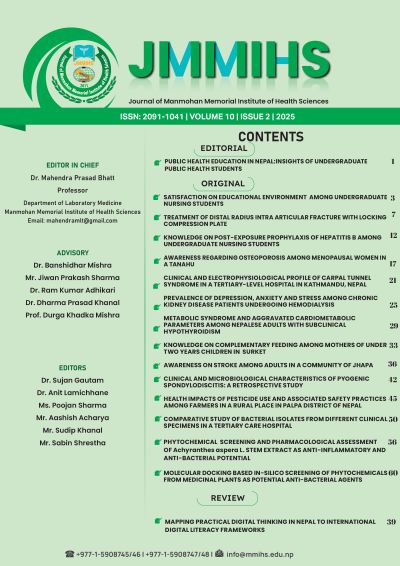
Clinical and Microbiological Characteristics of Pyogenic Spondylodiscitis: A Retrospective Study
Keywords:
Pyogenic Spondylodiscitis(PS)Abstract
Introduction: Pyogenic spondylodiscitis (PS) incidence is rising globally, but microbial profiles vary significantly by region. Local data is crucial for effective empirical therapy. This study aimed to analyze the clinical and microbiological characteristics of microbiologically confirmed PS cases at a tertiary hospital in Kathmandu, Nepal.
Method: We retrospectively reviewed 19 patients with culture-positive PS treated at Manmohan Memorial Teaching Hospital from January 2017 to December 2024. Data on demographics, comorbidities, inflammatory markers (CRP/ESR), pathogen identity, treatment modality, and clinical outcome were collected. Statistical analysis was performed using SPSS.
Result: The mean age was 58.8±15.4 years, and 78.9% were male. Neurological deficits were observed in 7 patients (36.8%). Lumbar/Dorso-lumbar spine involvement was most common (63.2%). Mean initial C-Reactive Protein (CRP) and Erythrocyte Sedimentation Rate (ESR) were 148.6±50.3 mg/L and 68.7±11.2 mm/h, respectively. The dominant pathogens were Staphylococcus aureus (47.4%) and Escherichia Coli (31.6%). Surgical intervention was required in 52.6% of patients. The overall clinical success rate was 94.7%.
Conclusion: The high prevalence of Gram-negative organisms, particularly E. Coli and endemic pathogens like Salmonella typhi, mandates that local empirical antibiotic protocols in Nepal ensure adequate coverage for Gram-negative bacilli. Aggressive, pathogen-specific treatment leads to excellent outcomes in this population.
Downloads
Published
How to Cite
Issue
Section
License
Copyright on any research article in JMMIHS is retained by the author(s).
The authors grant JMMIHS a license to publish the article and identify itself as the original publisher.
The corresponding author is responsible for any conflict of interest between authors and others. The journal is not responsible for concepts, ideas, and views reflected in the articles published in the journal. The article will be retracted if any violation of an ethical issue is detected.
The articles in JMMIHS are licensed under a creative commons licensing .
This license permits use, distribution, and reproduction in any medium, provided the original work is properly cited, and it is not used for commercial purposes.

