
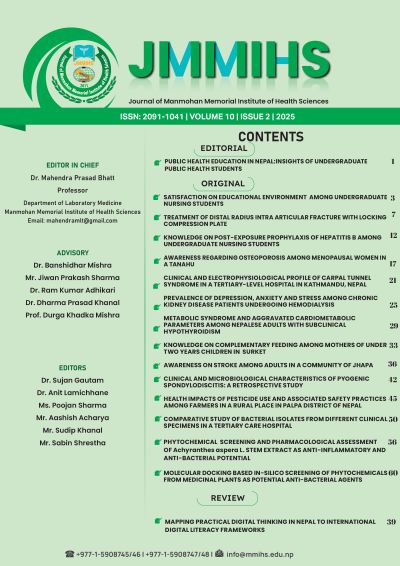
Molecular Docking Based In-Silico Screening of Phytochemicals from Medicinal Plants as Potential Anti-Bacterial Agents
Keywords:
Molecular Docking, Anti-bacterial, DNA-Gyrase, E-coli, Curcuma longa, Zingiber officinale, Zanthoxylum armatum, Allium sativumAbstract
Introduction: The anti-bacterial resistance has risen in a hurry, and the scarcity of new anti-bacterial medications has become one of the foremost global issues in the 21st century. Antimicrobial resistance, specifically antibacterial resistance has emerged as an urgent global health issue that compromises the effectiveness of infection treatment and prevention. Antimicrobial resistance estimated in 2014 that by 2050, AMR might be the cause for 10 million deaths.
Method: In-silico method was utilized to investigate identify potential anti-bacterial medicinal plants. PyRx integrated version of AutoDock, open babble, vina wizard and Biovia discovery studio were utilized to predict the scoring functions of active chemical constituent from different medicinal plants, with specific protein of gram-positive and gram-negative bacteria. Discovery studio visualizer and marvin sketch was used to create 2D and 3D structure, interaction, and various web server was utilized to predict and collect the data.
Result: Thirty-one active chemical constituents of different medicinal plants were designed and docked with DNA gyrase of Escherichia coli PDB-ID [1KZN] and [5L3J], Penicillin binding protein of Staphylococcus aureus PDB-ID [3VSL] and [1VQQ]. Active chemical constituents of Allium sativum show very low binding affinity below -4.7 kcal/mol, Zanthoxylum armatum shows below -6.3 kcal/mol, Zingiber officinale shows moderate binding affinity below -6.9 kcal/mol, Curcuma longa shows highest binding affinity below -8.4 kcal/mol with DNA gyrase and Penicillin binding protein. Out of Thirty-one active chemical constituents A15 Curcumin (-7.2, -7.5, -7.7, -7.1 kcal/mol), A16 Demethoxycurcumin (-7.9, -7.5, -7.1, -7.6 kcal/mol) and A17 Bisdemethoxycurcumin (-8.2, -7.2 -6.9, -8.4) shows the highest binding affinity. Out of Thirty-one only two Active chemical constituents A16, A17 shows Lead likeness. Physiochemical, Lipinski’s Rule and Pharmacokinetic parameters analyses shows that all active constituents have good physiochemical, pharmacokinetics parameters and moderate toxicological profile.
Conclusion: : In-silico analysis indicates a descending order of antibacterial potential Curcuma longa > Zingiber officinale > Zanthoxylum armatum > Allium sativum, based on molecular docking scores, physicochemical characteristics, Lipinski’s Rule of Five, predicted pharmacokinetic parameters, and toxicological profile. Molecular docking results demonstrated that bioactive constituents of Curcuma longa, particularly curcuminoids and its derivatives (A15 - Curcumin, A16 - Demethoxycurcumin, A17 - Bisdemethoxycurcumin), exhibited the most favorable binding affinities toward selected bacterial target proteins, suggesting strong ligand receptor interactions and high inhibitory potential. Hence, Curcuma longa shows potential antibacterial action among four locally available medicinal plants.
Downloads
Published
How to Cite
Issue
Section
License
Copyright on any research article in JMMIHS is retained by the author(s).
The authors grant JMMIHS a license to publish the article and identify itself as the original publisher.
The corresponding author is responsible for any conflict of interest between authors and others. The journal is not responsible for concepts, ideas, and views reflected in the articles published in the journal. The article will be retracted if any violation of an ethical issue is detected.
The articles in JMMIHS are licensed under a creative commons licensing .
This license permits use, distribution, and reproduction in any medium, provided the original work is properly cited, and it is not used for commercial purposes.

