Established in 2007 and hosted by Ubiquity.
Managed by Tribhuvan University Central Library.
Nepal Journals Online (NepJOL) is a service to provide online publication of Nepalese journals. For more information about NepJOL and how to join the service, see the About page.

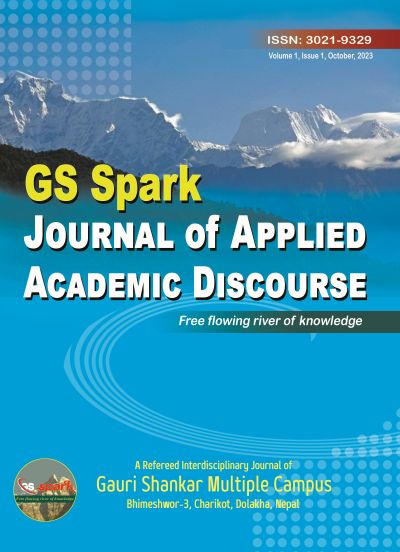
GS Spark: Journal of Applied Academic Discourse is a double-blind peer-reviewed multidisciplinary research journal designed to address the unique research demands of developing countries. It emphasizes the promotion of indigenous knowledge while fostering collaboration between scholars from developing and developed nations. The journal adopts an inclusive and accessible approach through its open-access policy and the absence of article processing charges, enabling wider participation from researchers with limited financial resources. The journal is committed to maintaining high academic standards by prioritizing scientific rigor, objectivity, and integrity over authorship identity. Its double-blind peer review system ensures unbiased evaluation, focusing on the quality and relevance of the research rather than the reputation of the author. Additionally, it incorporates structured abstracts and standardized reference formats to enhance clarity, consistency, and academic professionalism. Published from Nepal, the journal distinguishes itself with several notable features, including Google Scholar indexing, DOI assignment, open-access publication with ISSN, and proof of indexing in third-party platforms. Authors benefit from retaining copyright ownership, along with receiving publication and copyright certificates. The journal also ensures a rapid review process to facilitate timely dissemination of research findings. Initiated by Gaurishankar Multiple Campus, the journal responds to the disparity in research infrastructure and opportunities between developed and developing countries. By focusing on context-specific issues and practical applications, it provides a vital platform for underrepresented research areas. Supported by experts from diverse disciplines such as business, arts, technology, and social sciences, the journal strives to enhance the visibility, relevance, and impact of scholarly work in developing country contexts.