Editorial: Advancing Knowledge at the Intersections of Disciplines
Abstract
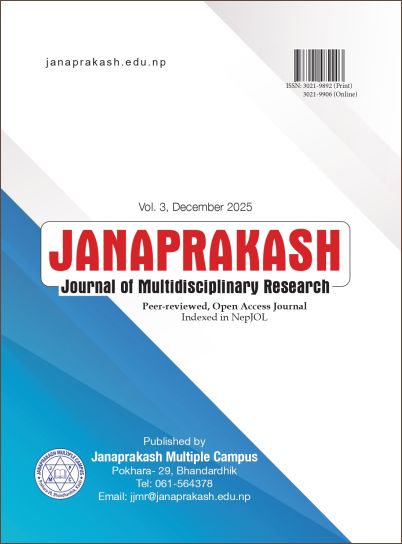
This issue of Janaprakash Journal of Multidisciplinary Research (JJMR) is the continuation of its periodic annual publication of Janaprakash Campus, Pokhara. The issue in your hand belongs to our third attempt which complies ten articles of different areas from different institutions. As we move forward, this journal seeks to expand its global reach by online version and inclusivity. We therefore encourage researchers across different regions and career stages, particularly studies that address local challenges with global implications. The challenges of the twenty-first century like climate change, social inequality, sustainable development etc are not the boundaries of single academic disciplines. So, multidisciplinary (MD) research work serving as a platform where diverse perspectives converge to generate integrative knowledge and encourage scholars to move beyond conventional framework, methods, and data from multiple fields to produce more holistic insights in an interconnected world. When researchers from different disciplines collaborate, they bring distinct epistemologies, analytical tools, and problem-solving strategies. These interactions often lead to novel research designs and unexpected discoveries.
To address such challenges, this journal emphasize clarity in conceptual framing, transparency in methodology, and coherence in integrating diverse perspectives. This journal is committed to promoting rigorous and ethically grounded research that bridges disciplinary divides. Hence, this journal helps translate academic knowledge into actionable insights. This translation is particularly vital in contexts where research outcomes directly affect public welfare, environmental sustainability, and technological governance. So, authors are encouraging to articulate how their work contributes to multiple fields by fostering collaboration and intellectual exchange across disciplines. Present journal aim to contribute meaningfull to the advancement of knowledge and to the development of sustainable solutions for an interconnected world. To keep this in mind, our peer review process plays a crucial role in ensuring the quality and impact of MD scholarship. Reviewers are selected not only for their disciplinary expertise but also for their openness to cross-disciplinary approaches. Constructive peer review fosters intellectual exchange and helps author refine their arguments for a broader scholarly audience. In this way, our review process becomes a collective endeavor that strengthen both individual contribution of the author, the reviewer as well as the journal’s overall mission. This editorial reflects - the importance of MD inquiry and highlights the embracing collaboration, methodological diversity in shaping impactful and socially relevant science. This editorial reaffirms our commitment to supporting such scholarship and invites researchers to engage in dialogue across disciplines for the collective advancement of knowledge. Thus, this journal can help shape the research work that is both intellectually robust and practically meaningful.
Finally, I would like to extend my sincere thanks to the authors who contributed their articles for this issue and to the reviewers for their contribution on enhancement of the manuscript. I would like to thank members of the editorial board who work hard for this issue. Sincere thanks are due to the authorities of RMC of this campus and to the real design.
Thank you.
Prof S K Lamichhane, Ph D.
Chief Editor
December, 2025
Downloads
Published
How to Cite
Issue
Section
License
Copyright (c) 2025 The Publisher

This work is licensed under a Creative Commons Attribution-NonCommercial 4.0 International License.
This license enables reusers to distribute, remix, adapt, and build upon the material in any medium or format, so long as attribution is given to the creator. The license allows for commercial use.

