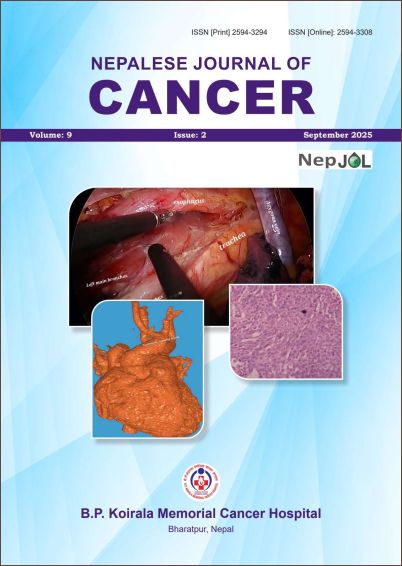
Evolution of Thoracic Surgery at BP Koirala Memorial Cancer Hospital, Nepal: An 18 – Year Journey of Innovation and Growth.
Keywords:
Thoracic surgery, Minimally invasive esophagectomy, NepalAbstract
Background: Thoracic malignancies constitute 15% of Nepal’s cancer burden, with lung cancer being the leading malignancy. This study aims at evolution of thoracic oncosurgery services at BP Koirala Memorial Cancer Hospital (BPKMCH) - Nepal’s premier tertiary cancer hospital during a period of 18 years (2007- 2025) to highlight procedural innovations, survival trends and resource-adapted strategies.
Methods: a retrospective analysis of 8683 surgical procedures stratified into: Foundation (2007-2010; open surgery), Expansion (2011-2015; Minimally Invasive transition), and Modernization (2016-2025, June; precision surgery). Data sources included hospital records, surgical database, and institutional publications.
Results: major surgeries increased 9-fold (106 in 2007 to 951 in 2024). Video-assisted thoracic surgery (VATS) biopsies achieved 98% diagnostic yield. Minimally invasive esophagectomy (MIS esophagectomy) rose from 0% to 80% (p <0.001) with 5-OS improvement from 17% to 27% (p=0.003). Pioneering milestones included Nepal’s first minimally invasive esophagectomy (2009), VATS Thymectomy (2011), Subxiphoid Uniportal Non-intubated Thymectomy (2025) and VATS non-intubated S9 sub lobar pulmonary resection (2025).
Conclusion: BPKMCH has become Nepal’s thoracic surgery referral hub through phased innovation. Future priorities include expansion of non-intubated thoracic surgeries and robotic surgeries.
Downloads
Published
How to Cite
Issue
Section
License
Copyright (c) 2025 Nepalese Journal of Cancer

This work is licensed under a Creative Commons Attribution 4.0 International License.
This license lets others distribute, remix, tweak, and build upon your work, even commercially, as long as NJC and the authors are acknowledged.
Submission of the manuscript means that the authors agree to assign exclusive copyright to NJC. The aim of NJC is to increase the visibility and ease of use of open access scientific and scholarly articles thereby promoting their increased usage and impact.

