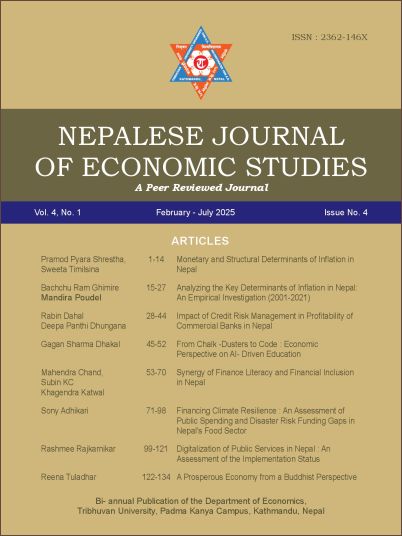
Financing Climate Resilience: An Assessment of Public Spending and Disaster Risk Funding Gaps in Nepal’s Flood Sector
Keywords:
Disaster Risk Financing, Flood Management, Public Expenditure, Climate Resilience, Funding Gap, Risk Transfer, Ex-ante Financing, Disaster Funding GapAbstract
Nepal is becoming progressively susceptible to climate-induced disasters, particularly recurrent floods that continue to cause substantial economic and social repercussions. Notwithstanding significant advancements in the development of regulatory frameworks and institutional structures for disaster risk reduction and management (DRRM), the nation nonetheless encounters enduring financing deficiencies that obstruct proactive resilience enhancement. The study evaluates the magnitude of public financing deficiencies for flood-related disaster risk in Nepal by juxtaposing historical economic losses from floods with actual government and foreign funding streams from 2003 to 2023. The research uses quantitative methodologies, such as per capita normalization, GDP adjustments, and inferential statistical testing, to identify significant discrepancies between necessary and available financing. Findings suggest that although some years recorded funding surpluses, long-term trends demonstrate a normalized cumulative deficit surpassing NPR 508 million. However, beyond this apparent quantitative gap lies a deeper qualitative deficiency. Most funding remains reactive, centered on post-disaster humanitarian aid, with limited evidence in preparedness, recovery, or long-term resilience. Ex-ante financial instruments such as insurance, catastrophe bonds, risk pooling, and contingent credit-are underutilized or absent. Despite DRRM policies being well-documented, their implementation has been weak, and financial resources often fail to support proactive disaster planning.
The Wilcoxon Signed-Rank Test confirms a statistically significant mismatch between authorized funding and actual flood-induced losses, reflecting inefficiencies in both resource allocation and institutional response. The study underscores the urgent need for a transition from reactive, ad hoc aid to a proactive, risk-informed financing approach. It recommends greater adoption of ex-ante instruments and alignment of DRR policy commitments with implementation practices. Strengthening financial planning, improving budget execution, and exploring innovative disaster finance mechanisms are essential to enhance Nepal’s resilience to floods and reduce recurring economic damages.
JEL Classification: H84, Q54, G22, O23
Downloads
Published
Issue
Section
License
Copyright (c) 2025 Department of Economics, Padma Kanya Multiple Campus, Tribhuvan University

This work is licensed under a Creative Commons Attribution-NonCommercial-NoDerivatives 4.0 International License.
This license enables reusers to copy and distribute the material in any medium or format in unadapted form only, for noncommercial purposes only, and only so long as attribution is given to the creator.

