Guidelines for Reviewer

The following points should be considered when reviewing the article:

  1. Does the article that needs to be reviewed fall under your specialization or expertise?

In case you receive an article that is not relevant to your area of expertise, then please do let the editor know immediately about it and recommend another person for the review and provide his or her e-mail and phone numbers.

  1. Do you have the time to undertake the task of reviewing the article?

Article reviews are expected to be completed within a period of two weeks. If you cannot complete the article review in a period of two weeks, then please inform the editor and recommend a new person for the job along with his or her e-mail and phone numbers.

  1. Are there any possible conflicts of interest?

Even though possible conflicts of interest will not impede your role as reviewer in evaluating the manuscript, informing the editors about any possible conflicts of interest will be a wise move on your part. Do not hesitate to contact the editorial office if you are in any doubt concerning any possible conflicts of interest.

The Review Process

While reviewing the manuscript sent to you for evaluation, kindly take note of the following:

  1. Content Quality and Originality,
  • Is the content novel and interesting enough to make it worthy of publication?
  • Does the content add anything new to the existing body of literature?
  • Does the content fulfill the stipulated criteria for inclusion in the journal?
  • Is the research problem significant enough to merit publication in the journal?
  • You may consider the research in the context of its percentile rating to help determine its originality and suitability.


Organization and Clarity of the Manuscript

Title: Is it reflective of the article?

Abstract: Does it mirror the contents of the article?

Introduction: Did it accurately explain what the author had aimed to achieve, and did the author give an accurate statement of the problem under investigation? Normally, the introduction must contain a summary of previous research done so as to give some context as well as an explanation of whether the current author is extending or opposing previous researchers' findings.

Methods:

  • Has the author explained the research methodology?
  • Does he explain data collection process correctly?
  • Is the chosen methodology adequate for addressing the research problem?
  • Is there enough information to allow for replication of the study?
  • Does the article mention the methodologies used?
  • Are they presented in an intelligible manner?
  • Do they follow a logical order? Are details provided on how new methodologies can be

used if any?

  • Is there an appropriate sampling procedure?
  • Are the equipment and materials involved in the research discussed?
  • Does the article clarify the type of data that were collected by the researcher; is he precise

in explaining the measurement techniques?

  • Does he use proper statistical procedures in the research?

Results: Here, the author(s) must describe in writing what the findings of the research were. The findings must be clearly written and logical in their presentation. You will need to take into consideration the following points:

  • Is the presentation of data appropriate, in tables and graphs?
  • Has the statistics that was discussed in the methods been correctly used?
  • Are the statistics accurate? If you do not have any experience with statistics, please inform

the editor while you write your review.

Conclusion/Discussion:

  • Do the claims made by the author (in the conclusion) match the results stated in the results

section of the paper?

  • Does the conclusion appear to make sense?
  • Have the authors stated the relation of their results to past work/research?
  • Do the results either support or refute past studies or ideas/theories?
  • Is there justification for doing so?
  • Has there been progression in the science as a whole?

Tables, Figures and Illustrations:

  • Are they relevant?
  • Do they represent the data correctly?
  • Are they clear and comprehensible?

Scope – Is the paper consistent with the journal’s objectives and scope?

Source - Elsevier Guidelines for Reviewers

Reviewers are also advised to consider the following guidelines on peer review by the ICMJE and COPE respectively.

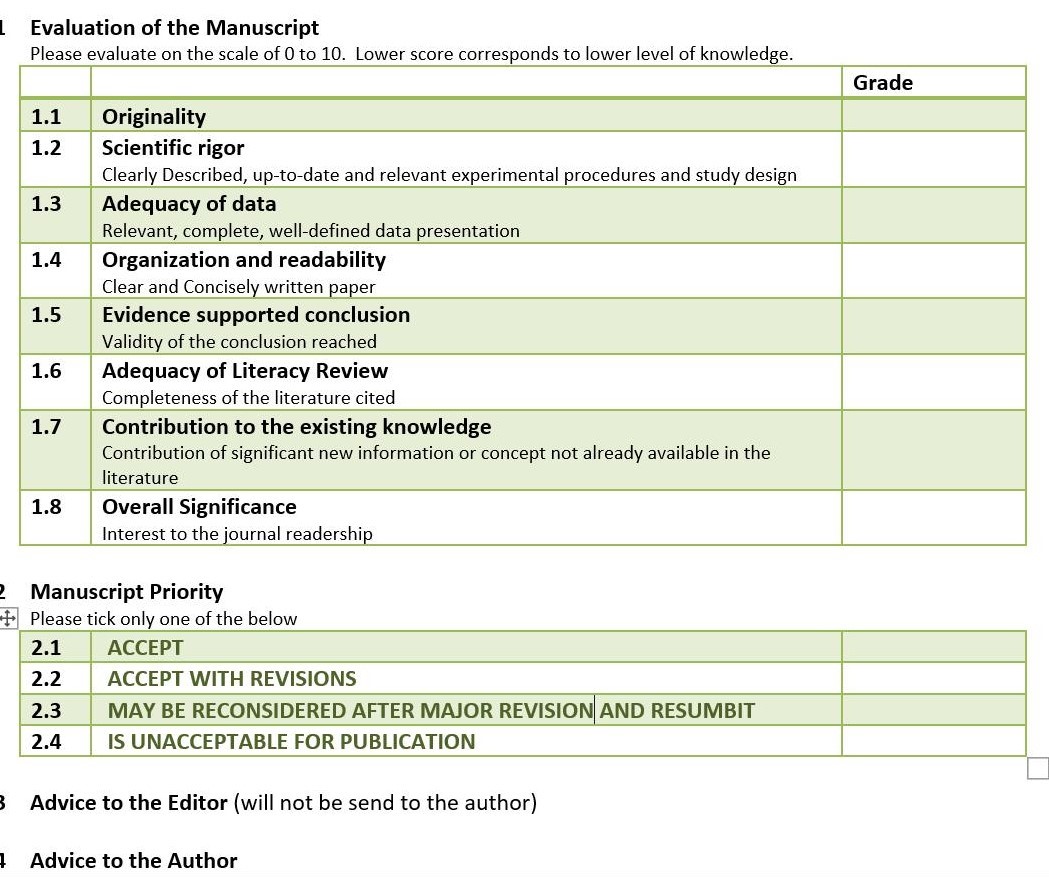
The reviewer is kindly asked to give his/her comments using the NPRC Journal of Multidisciplinary Research peer review format shown below. This format can be accessed by reviewers when submitting their comments online.
