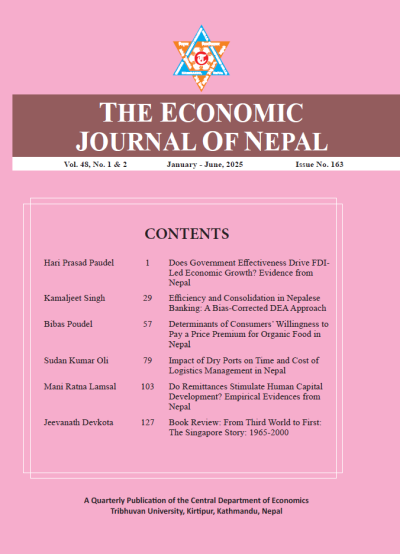
Does Government Effectiveness Drive FDI-Led Economic Growth? Evidence from Nepal
Keywords:
Foreign direct investment, Government effectiveness, Economic growth, ARDL modelAbstract
The study empirically examines the impact of foreign direct investment (FDI) on economic growth in Nepal and evaluates the moderating role of government effectiveness. Using an ARDL model and annual time-series data from 1996 to 2024, the bounds test indicates a stable long-run relationship among the variables. The findings show that foreign direct investment has a positive and significant impact on growth in both the long run (β=0.05, p<0.01) and the short run (γ=0.01, p<0.05). Conversely, government effectiveness shows negative and weakly significant effects in the short run (γ = -0.045, p < 0.1), but is insignificant in the long run due to persistent institutional instability in Nepal. Crucially, the interaction between FDI and government effectiveness was positive and statistically significant in both the long run (β=0.45, p<0.01) and the short run (γ=0.14, p<0.01). The findings show that good governance and strong institutions play a vital role in amplifying the growth-enhancing effects of FDI by operationalizing effective policies, thereby fostering a favorable environment for foreign investors and enhancing capital inflows. Therefore, Nepal should prioritize institutional improvements and effective policy implementation to attract more FDI and foster economic growth.
Downloads
Published
How to Cite
Issue
Section
License
© Cedecon-TU


