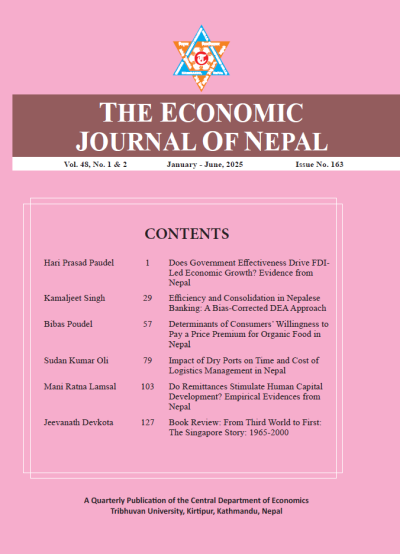
Do Remittances Stimulate Human Capital Development? Empirical Evidences from Nepal
Keywords:
Remittance, Human development, ARDL bounds testing, Long run, NepalAbstract
Remittances have become an increasingly important driver of economic development, as they are more stable and reliable and are among the most emerging sources of funds for developing economies, including for human capital development. Nepal consistently ranks among the world’s top remittance recipients relative to Gross Domestic Product, as many Nepalese work abroad. Remittance inflows not only sustain the consumption of necessities but also finance investment in education and health, thereby advancing human development. Despite the prominent role of human development in the growth of the Nepalese economy, the relationship between remittances and human capital development has been examined only sparsely. The objective of the paper is to analyze the effect of remittances on human capital development using annual time series data spanning 1993 to 2023, collected from the World Development Indicators and the World Bank, and employing the ARDL and ECM approaches to investigate the short-run and long-run dynamics. Human development is regressed on remittance inflows as the key explanatory variable, along with education expenditure and health expenditure as other control variables. The findings show a statistically significant positive relationship between remittance inflows and human development in both the short and long run. The study contributes to a broader understanding of how foreign migration-induced income inflows support human development in remittance-receiving developing countries like Nepal.
Downloads
Published
How to Cite
Issue
Section
License
© Cedecon-TU


