Unlocking Clinical Precision Through Polygenic Risk Prediction
Keywords:
Polygenic Risk Prediction, Genomic medicine, Genome-wide association studies, NepalAbstract
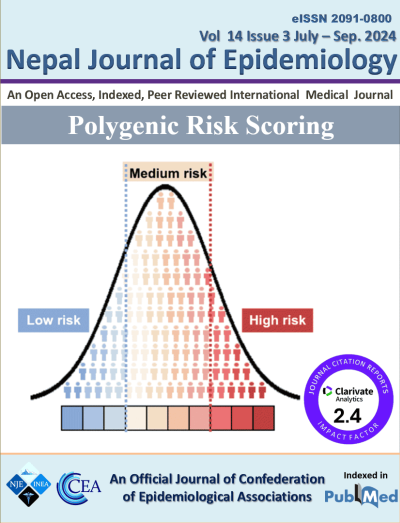
Genomic medicine has undergone significant changes over the last decade. The Polygenic Risk Score (PRS), which combines the impact of hundreds to millions of genetic variations to approximate an individual's risk of developing a complex disease (such as coronary artery disease, diabetes, or Alzheimer's disease), is one of the most promising tools. In comparison to monogenic variants, which can carry high and uncommon risks, polygenic models offer predictive capabilities for the population. However, these findings have not yet been translated into clinical care.
Abstract
186
PDF
34
Downloads
Published
2024-12-31
Issue
Section
Editorial
License
Copyright (c) 2024 CEA & INEA

This work is licensed under a Creative Commons Attribution 4.0 International License.
- Upon acceptance Copyright on any research article is transferred in full to the Confederation of Epidemiological Associations (CEA) and International Nepal Epidemiological Association (INEA). The copyright transfer includes the right to reproduce and distribute the article in any form of reproduction (printing, electronic media or any other form).
- Articles in the Nepal Journal of Epidemiology are Open Access articles published under the Creative Commons CC BY License (https://creativecommons.org/licenses/by/4.0/)
- This license permits use, distribution and reproduction in any medium, provided the original work is properly cited.
How to Cite
Sathian, B., Iqbal, J., Banerjee, I., & Al Hamad, H. (2024). Unlocking Clinical Precision Through Polygenic Risk Prediction. Nepal Journal of Epidemiology, 14(3), 1344-1345. https://doi.org/10.3126/nje.v14i3.82370


