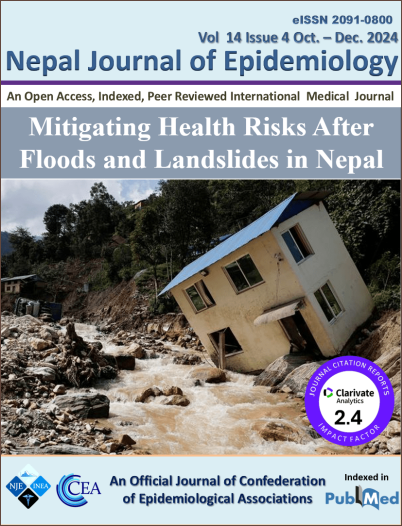
Mitigating Health Risks After Floods and Landslides in Nepal: A Public Health Perspective
Keywords:
flood, mitigation, health riskAbstract
In summary, the current floods reveal the deeply seated public health vulnerabilities in this disaster-ridden region, and they are a grim reminder of the catastrophic impacts of climate change on our environment. Massively reducing the immediate risk of disease outbreaks requires immediate interventions. At the same time, longer-term strategies need to address the psychological and infrastructural wreckage. Through strengthening health systems, increasing community understanding and improving preparedness for disasters, Nepal can reduce the public health impact of future disasters and protect the well-being of its people.
Abstract
149
PDF
1
Downloads
Published
2024-12-31
How to Cite
Simkhada, P., Sathian, B., Simkhada, B., van Teijlingen, E., & Koirala, P. (2024). Mitigating Health Risks After Floods and Landslides in Nepal: A Public Health Perspective. Nepal Journal of Epidemiology, 14(4), 1359-1361. https://doi.org/10.3126/nje.v14i4.83897
Issue
Section
Editorial
License
Copyright (c) 2024 CEA & INEA

This work is licensed under a Creative Commons Attribution 4.0 International License.
- Upon acceptance Copyright on any research article is transferred in full to the Confederation of Epidemiological Associations (CEA) and International Nepal Epidemiological Association (INEA). The copyright transfer includes the right to reproduce and distribute the article in any form of reproduction (printing, electronic media or any other form).
- Articles in the Nepal Journal of Epidemiology are Open Access articles published under the Creative Commons CC BY License (https://creativecommons.org/licenses/by/4.0/)
- This license permits use, distribution and reproduction in any medium, provided the original work is properly cited.
How to Cite
Simkhada, P., Sathian, B., Simkhada, B., van Teijlingen, E., & Koirala, P. (2024). Mitigating Health Risks After Floods and Landslides in Nepal: A Public Health Perspective. Nepal Journal of Epidemiology, 14(4), 1359-1361. https://doi.org/10.3126/nje.v14i4.83897


