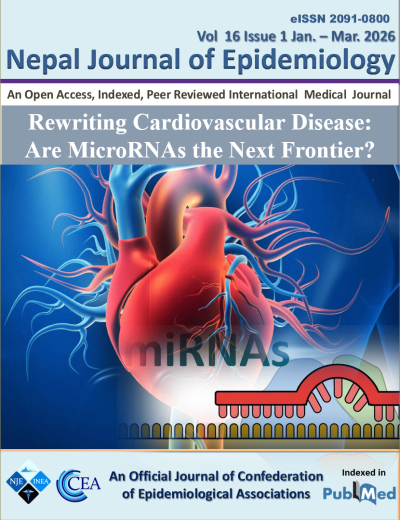
Rewriting Cardiovascular Disease: Are MicroRNAs the Next Frontier?
Keywords:
MicroRNAs, Circulating MicroRNA, RNA, Nucleic Acids, Cardiovascular System, Cardiovascular Diseases, Heart DiseasesAbstract
Cardiovascular disease is the leading cause of mortality worldwide, claiming the lives of roughly 18 million individuals annually. MicroRNAs have been found to have a highly active role in the pathogenesis and progression of Cardiovascular disease. The top 10 studied MicroRNAs in cardiovascular disease are namely miR-1, miR-208, miR-21, miR-29, miR-126, miR-145, miR-133, miR-155, miR-30 and miR-499.The potential and the development of the use of MicroRNAs will open up a new frontier in molecular cardiology and will further expand the frontier of precision medicine. MicroRNAs are almost limitless in their capabilities therapeutically, as they can be mimicked or inhibited, depending on their specific mechanism.
It is evident that microRNAs will be a vital tool that both saves a countless number of lives as well as aids in reducing the mortality and morbidity in patients suffering from chronic diseases, most specifically in cardiovascular diseases. Their clinical and therapeutic potential are almost limitless and will someday be a mainstay in patient management and treatment.
Downloads
Published
How to Cite
Issue
Section
License
Copyright (c) 2026 CEA & INEA

This work is licensed under a Creative Commons Attribution 4.0 International License.
- Upon acceptance Copyright on any research article is transferred in full to the Confederation of Epidemiological Associations (CEA) and International Nepal Epidemiological Association (INEA). The copyright transfer includes the right to reproduce and distribute the article in any form of reproduction (printing, electronic media or any other form).
- Articles in the Nepal Journal of Epidemiology are Open Access articles published under the Creative Commons CC BY License (https://creativecommons.org/licenses/by/4.0/)
- This license permits use, distribution and reproduction in any medium, provided the original work is properly cited.

