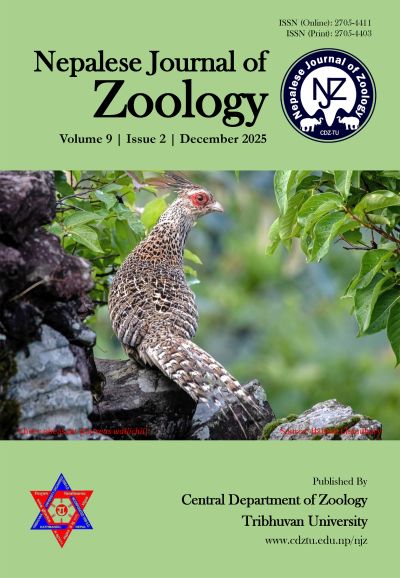
Population density of cheer pheasant (Catreus wallichii) in Lower Kali Gandaki Valley of Annapurna Conservation Area, Nepal
Keywords:
Pheasants, Galliformes, Threatened Species, Call-count Survey, Himalayas, Breeding population, Population EstimationAbstract
The cheer pheasant (Catreus wallichii), a globally vulnerable galliform, has experienced long-term decline due to habitat loss, hunting, and anthropogenic pressures in Nepal. In Nepal, the species is confined to fragmented scrub and grassland habitats, for example, the Lower Kali Gandaki Valley of the Annapurna Conservation Area (ACA) with previous reported declining population. To establish the current population status, we conducted a call count survey at seven listening posts in Lower Kali Gandaki Valley of Annapurna Conservation Area, Nepal between late April and early May 2025. We recorded 18 pairs of cheer pheasant in the study area, with an average density of 9.18 pairs/km2. Site-specific results revealed clear variation across locations ranging from 17.86 pairs/km2 at Pangpu Kharka to none at Sekung Kharka. When compared with earlier studies, the current population appears to have rebounded to its highest level in two decades. Overall, our findings highlight both the pheasant’s capacity for recovery and its continued vulnerability to human and environmental pressure. This study suggests the need for a detailed study on interaction and resources use practices by locals and livestock in the habitat of the cheer pheasant. Effective conservation action requires a focus in habitat management outside protected areas through community-based initiatives, regular monitoring, and control of land uses crucial to survival and success of grasslands.
Downloads
Published
How to Cite
Issue
Section
License
Copyright (c) 2025 The Author(s)

This work is licensed under a Creative Commons Attribution-NonCommercial 4.0 International License.
This license enables reusers to distribute, remix, adapt, and build upon the material in any medium or format for noncommercial purposes only, and only so long as attribution is given to the creator.

