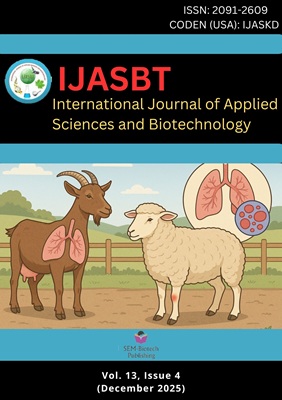
Isolation and Characterization of Mycoplasma capricolum subsp. capripneumoniae from Sheep and Goat Pneumonic Lungs
Keywords:
Mycoplasma capricolum subsp. capripneumoniae; Sheep, goatAbstract
Mycoplasma capricolum subsp. Capripneumoniae (Mccp) is the causative agent of contagious caprine plueropneumonia (CCPP). In many countries CCPP is diagnosed by clinical signs and serological methods only. Mccp is known to be difficult to culture in the laboratories due to the fastidious nature of the organism. In the Sudan, there is need for further studies on sheep and goat pneumonia. The aim of this study was to determine the frequency of Mccp in ovine and caprine pneumonic lungs and to study the histopathology of the affected lungs. Tissue samples were obtained from condemned lungs of slaughtered sheep and goats and from clinically ill goats in Omdurman, Khartoum State, Sudan. Bacteriological culture and PCR methods were used to detect Mccp. Histopathological evaluation was also performed. Mccp DNA was identified in 4 goat and one sheep sample using PCR, while only one of them- goat lung sample- was identified using bacteriologic culture lung samples. None of the detected microscopic lung lesion could be considered specific for Mccp infection. This study documents for the first time, the presence of Mycoplasma capricolum subsp. capripneumoniae (Mccp) DNA in pneumonic sheep lung in Sudan suggesting that sheep may act as potential carriers of CCPP and/or clinically affected animal species. This highlights the need for further investigation into the epidemiological role of sheep in the transmission of CCPP. Although PCR is more costly than traditional bacteriological culture, it proves to be a valuable tool for CCPP surveillance due to its higher sensitivity and specificity.
Int. J. Appl. Sci. Biotechnol. Vol 13(4): 146-152.
Downloads
Published
How to Cite
Issue
Section
License
Copyright (c) 2025 International Journal of Applied Sciences and Biotechnology

This work is licensed under a Creative Commons Attribution-NonCommercial 4.0 International License.

