Established in 2007 and hosted by Ubiquity.
Managed by Tribhuvan University Central Library.
Nepal Journals Online (NepJOL) is a service to provide online publication of Nepalese journals. For more information about NepJOL and how to join the service, see the About page.

Dristikon (दृष्टिकोण) is a multidisciplinary journal published by the Research Management Cell of Mahendra Multiple Campus, Dharan, Nepal. The focus of this peer-reviewed journal is to bring a platform for research enhancement at an advanced level. Its scope includes the publication of multi-disciplinary articles based on the guidelines of UGC, Nepal and international standards. All the articles submitted for publication are subjected to rigorous double-blinded peer review to ensure their quality before it gets published.
The primary objective of a research article is to convey new information that is supported by evidence, and all claims made by the authors should be thoroughly scrutinized before being published. Its ability to produce more refined sentences surpasses those of the unedited ones. It is capable of providing an edited paragraph within seconds and, currently, it is available for free to everyone.
Current Issue
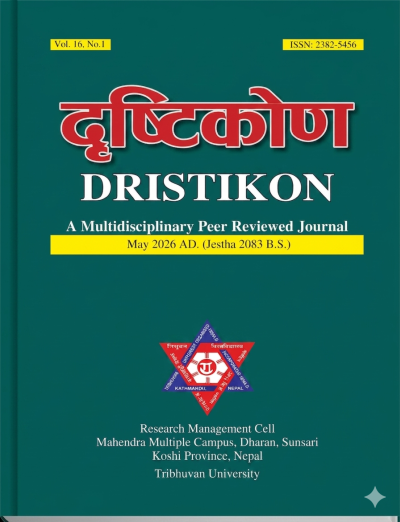
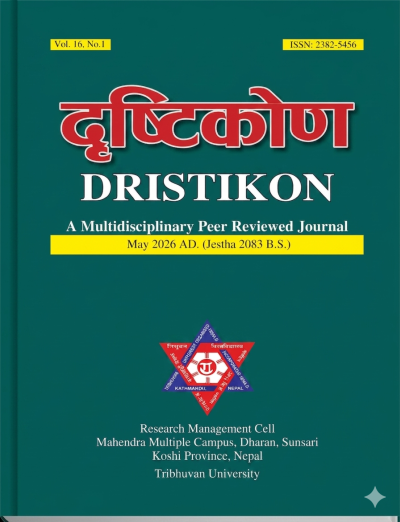
With great joy, the Mahendra Multiple Campus Research Management Cell (RMC) announces once more that the yearly transdisciplinary peer-reviewed magazine Dristikon, vol. 16(1), was successfully published in 2026. In compliance with the criteria and guidelines set forth by the UGC, Nepal and international academic publishing procedures, this issue has undergone a thorough editorial and peer-review process. The purpose of the peer-review process is to make sure that scholarly publications that are genuine and well-structured are accepted, that manuscripts that need editing are improved, and that submissions that are inappropriate are rejected. All of the reviewer recommendations were thoroughly considered and approved by the editorial board. The main objective of a research article is to communicate new knowledge supported by credible evidence. A broad spectrum of academic disciplines, including Nepali, English, Economics, Sanskrit, Education, Psychology, and Management, are represented among the articles accepted for the current edition. The editorial board truly appreciates the helpful comments, suggestions, and observations given by the peer reviewers. A big thank you goes out to everyone who helped with the publication of this research journal. A big thank goes to Assoc Prof. Chandra Kumar Rai, CC for his ongoing financial and administrative assistance in getting this publication finished.