Interdisciplinarity Research in Education: An amalgam in a variety of academic flavors
Abstract
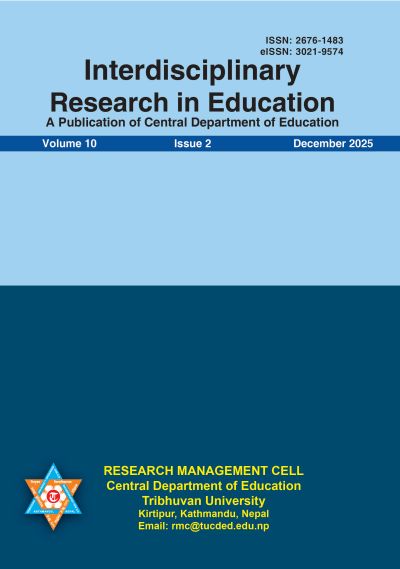
We are in the era of globalization, collaboration and interdisciplinarity practices of academic activities. So, in this context of the world, we need entrepreneurship research based standard education system in Nepal. Also, we need to explore new concepts and discussions on their applications in productive perspective. Thus, this issue (Volume 10, Issue 2nd) of Interdisciplinary Research in Education (IRE) published by Research Management Cell (RMC), Central Department of Education, Tribhuvan University presents a diverse area of studies. The individual and collaborative articles included in this issue expressed various concerns in education. We are happy to announce the release of this volume as a scholarly contribution of the Central Department of Education. This issue consists different research-papers from various disciplines, contributing to academic knowledge in different subject areas like inclusive education, mathematics, geography, languages, etc. Few articles are written in English which shed light on different aspects of education. Similarly, few articles are written in Nepali language. A good interdisciplinarity has been seen in the texts of this issue like previous issues in which the authors have explored and reflected their research concern lucidly. In such perspective these issues as an amalgam in a variety of academic flavors and this taste as reflections of the papers are expressed below.
Talking about the articles in the present issue, the scholars Nam Raj Neupane, Narayan Prasad Adhikari and Prof. Basu Dev Kafle exploring historical and transformative perspective of education in terms of inclusion in Nepal with paradigm shifts in education from the inclusion perspective through the article entitled ‘Genealogy of Inclusive Education in Nepal’. Sapana Adhikari and Suman Kumar Shrestha expressed their views of opportunities in geography education regarding the ICT Education at the Higher Level.
In Nepali language, a scholar Dinesh Ghimire elucidate School-level Nepali language curriculum in terms of thematic dimensions. Also, Umesh Kafle analyzes students' listening achievement based on their parents' educational background. Regarding the mathematics education, Bed Prasad Dhakal explored the ‘students’ learning experience while using AI based learning resources in higher mathematics education. Ajanta Maharjan Singh and Sushma Dhakal expressed Students’ Satisfaction on Academic Environment in a Nursing Campus regarding the nursing campus perspective.
Next, Krishna Prasad Adhikari, Prof. Lekhnath Sharma and Dirgha Raj Joshi explored how teachers and students experience online assessment design, implementation, and integrity in mathematics in their paper ‘Online Assessment Practices in Mathematics: Insights from Nepali Universities’.
The publication of articles and a journal is a very tedious task even though the publication of this issue has been possible because of the hardships made by different scholars specially, the scholars that handled the academic and technical effort to manage the task sincerely as recognized by the RMC team. So, we express best warm wishes and thanks to them. We express our sincere gratitude to the Head of the Central Department of Education, (T.U.) as the Patron of this journal. Also, we are grateful to authors, reviewers, and editorial team and the members of RMC. Also, the credit goes to the scholars who help and suggest us directly or indirectly with their time and insights subjectively.
Last, but not the least, we encourage the scholar community to contribute this journal “Interdisciplinary Research in Education” by providing original and constructive research papers for the next upcoming issues. The views and the phenomenon expressed by the writers in the corresponding paper are their own concerns and concepts; so, it’s responsibility goes to them correspondingly. RMC Editorial board being tried to manage those articles which are authenticate in AI detection and authentic similarity by detecting and plagiarism test. At the end, we highly appreciate the suggestions and feedbacks to enhance the quality of articles in the forthcoming issues.
Downloads
Published
How to Cite
Issue
Section
License
Copyright (c) 2025 Interdisciplinary Research in Education

This work is licensed under a Creative Commons Attribution-NonCommercial 4.0 International License.
This license enables reusers to distribute, remix, adapt, and build upon the material in any medium or format for noncommercial purposes only, and only so long as attribution is given to the creator.


